Letters from the Periphery
B. S. DARA
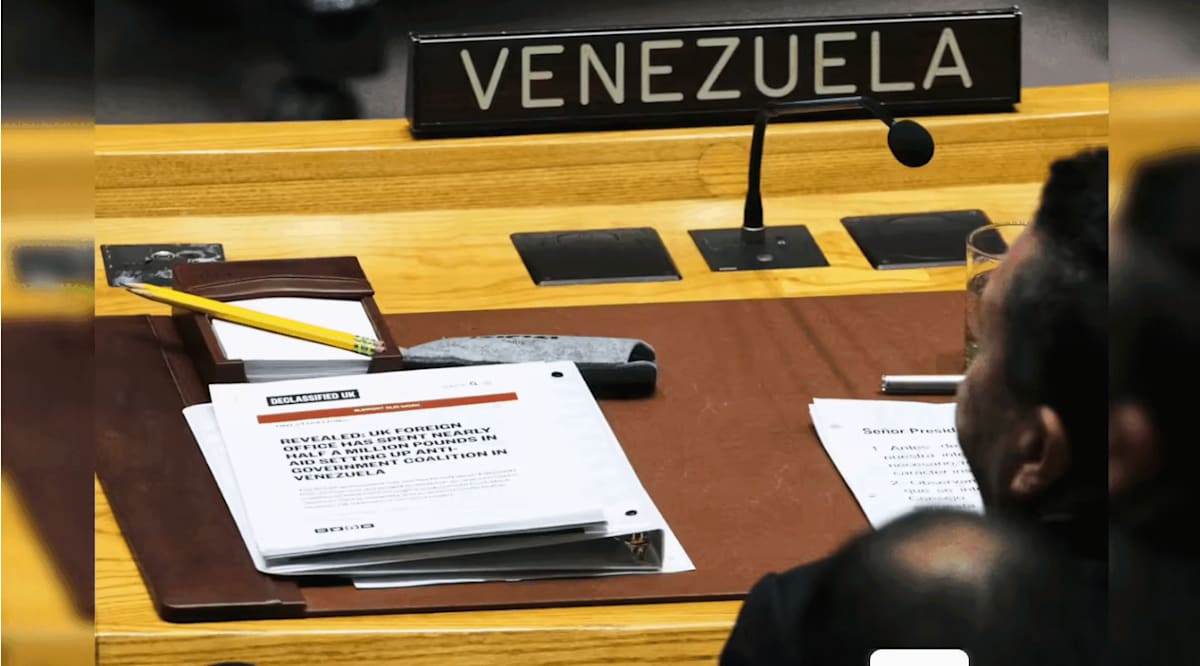
The United States has taken an extraordinary step by capturing Venezuela’s sitting leader, Nicolas Maduro, through a direct military operation and declaring its intention to oversee the country’s political transition. Whatever one’s view of Maduro, the manner in which this was done marks a significant moment in global affairs. It was not carried out through international institutions, regional consensus, and a collective mandate. It was done unilaterally, announced after the fact, and defended as necessary by Washington.
This action matters less for what it changes inside Venezuela and more for what it signals outside it. A sitting head of state was removed by force by another country, transferred across
borders, and placed under that country’s legal system. The United States has also stated that it will play a central role in governing Venezuela for an open period of time. This action goes beyond a limited, covert operation and reflects an open exercise of control.
Governments are looking beyond Maduro and assessing what this episode shows about how far powerful states are now willing to go. The message being absorbed is that if a country is strong enough, it can decide when rules apply and when they do not. Legal debate follows later, if at all.
Moscow, which has long argued that power rather than international law determines outcomes, is likely to draw direct conclusions from this episode. In its own narrative around Ukraine, Russia claims that Western states invoke international norms selectively. The Venezuela operation strengthens that argument. Russian officials can now point to a clear example of a Western power removing a foreign leader through force and assuming control without broad international approval. This does not justify Russia’s actions, but it does weaken the moral leverage used against it.
China will study this development carefully. Beijing pays close attention to how the international community reacts to major disruptions. It looks at whether allies remain aligned, how quickly attention shifts, and whether economic and political costs follow. Taiwan remains central to Chinese planning. China prefers long timelines and controlled pressure, but it also evaluates how far major powers can go without facing serious consequences. When unilateral action of this scale is normalised, it lowers the perceived cost of decisive moves elsewhere, even if no immediate change follows.
In East Asia, the reaction will be quieter but more anxious. Japan and South Korea predictably rely on the United States for military strength. Their security planning assumes that major decisions will be coordinated and that commitments will not change suddenly. The Venezuela operation reinforces doubts created during Donald Trump’s earlier term. He has repeatedly framed alliances as transactions. When security appears conditional, allies start preparing for scenarios in which support may be delayed and reduced.
This leads to practical consequences. Countries invest more in their own military capacity. Regional defence cooperation deepens. Longstanding taboos around deterrence and escalation are revisited. These changes are gradual, but over time they place increasing strain on regional stability.
Europe faces a similar challenge through NATO. Trump has long criticised the alliance, often citing financial contributions. More importantly, he has questioned the principle of automatic collective defence. That principle is the foundation of deterrence in Europe. If it appears uncertain, even rhetorically, it invites testing. The Venezuela action reinforces the idea that Washington is comfortable acting alone and defining legitimacy on its own terms.
The case also raises broader questions about how the United States sees its role in a world that is no longer dominated by a single power. American officials recognise that the global system is now multipolar. China, Russia, and several regional powers have the capacity to resist pressure. Middle powers, including those in the Gulf, have built diversified foreign policies to reduce dependence on any one partner. Such actions point to a preference in Washington for independent decision making rather than collective management.
This creates tension. A multipolar system functions better when large powers rely on consultation, predictable commitments, and restraint. When unilateral action becomes the default response, trust erodes. Countries still cooperate where interests align, but they hedge more aggressively. They avoid binding commitments. They keep their options open.
The Venezuela operation also revives a familiar concern in Latin America. The region has a long history of external intervention justified by security, democracy and stability. When intervention is carried out openly and justified directly, it strengthens the view that sovereignty depends on strength rather than formal principles. Smaller states then adjust by aligning with stronger partners, tightening internal controls and keeping distance from major power competition.
Discussion around possible future moves by the United States, including interest in strategically located territories elsewhere, fits into this broader pattern. Whether or not such moves occur is less important than the mindset they reveal. They suggest a view of international politics where advantage is pursued directly and consultation is secondary. Other governments adjust their expectations accordingly.
This approach does not produce immediate instability, but it gradually changes how states behave. Formal rules continue to exist, yet confidence in their ability to limit powerful actors weakens. Enforcement is seen as uneven, and security guarantees as conditional. In response, countries increase their focus on self-reliance, regional cooperation, and deterrence.
For states in the Gulf, this development carries clear implications. Stability depends increasingly on diversified partnerships, credible diplomacy, and internal resilience. Mediation and balanced engagement become more valuable as trust between major powers weakens. The ability to maintain working relationships across competing blocs is no longer optional. It is necessary.
The United States continues to operate within the international system, but recent actions show a readiness to bypass it when it is seen as restrictive.That choice will be studied closely by rivals, allies, and smaller states alike. The precedent set in Venezuela will influence expectations far beyond the region. Once such actions are accepted as normal, reversing that trend becomes difficult.
Global order changes gradually through specific actions that alter expectations. The detention of a sitting head of state by a foreign power, combined with a stated intention to oversee that country’s future, represents such an action. The longer-term impact will depend on subsequent US decisions and on how other states respond to this precedent.
History has a way of mocking power. In moments like these, irony speaks louder than argument and poetry becomes prophecy. It now feels written for this moment what Allama Iqbal once warned:
Uth jaaye agar zameer, to badal jaati hai taqdeer,
Phir taaj bhi mitti, takht bhi khaak hota hai.